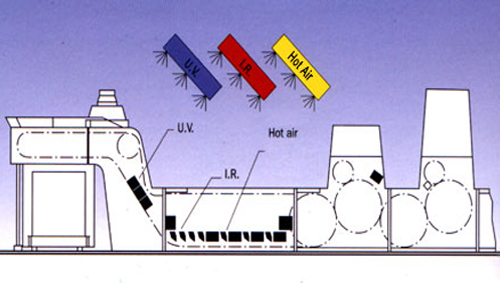
|
Infrared [IR]
Infrared (IR) is a part of the electromagnetic
spectrum with a wave length of 1.1 to 1.6 microns and lies just beyond
red colour of visible light. Infrared radiation is invisible. However,
it has properties similar to light i.e., it travels at the speed of
light; it can be directed or focused and it can travel even in vacuum.
When IR radiation is absorbed by an object, heat is generated
internally in the object as IR radiation causes atoms of the object to
vibrate, raising their temperature (temperature of any substance is a
measure of the severity of vibrations of its atoms). The best known
drying procedure to-date is infrared radiation drying with short-wave
spectrum. Conventional inks are used in conjunction with IR drying. By
heating up the ink (or coating) a reduction in viscosity is achieved
considerably improving the ink absorption, especially on absorbent
substrates.
Hot Air
The application of heat (IR radiation) drives the
water to the surface and evaporates part of it. Thermo - air slit
nozzles direct a high volume of air against the direction of travel of
the web or sheet at high speed and brings it right up against the
surface of the material being printed. This results in damp air being
exchanged for dry, warm air, promoting drying of the dispersion
coatings.
Ultraviolet [UV]
A condition for using this drying system is usage
of UV-reactive inks and coatings. It is not the acceleration of a
chemical process (oxidation), as with IR drying, which is involved
here, but polymerization triggered by UV radiation. The chains of
molecules present in the inks and coatings are stimulated suddenly to
polymerize (cross-link) by photo initiators which react to UV
radiation.
|